Mentorship

Some of the most rewarding work I do is helping students carry out their first real research project. I mentor high school, undergraduate, and early graduate students one-on-one in computational neuroscience, AI, and data science. Over a project, each student goes from a broad interest to a focused question, analyzes real data or literature, and writes a complete research paper.

Below are snapshots of projects my students have completed or are working on now. They span brain imaging, machine learning for medicine, genetics, and cognitive science.

25+students mentored
11featured projects
9completed papers
3conference & fair presentations

Student research

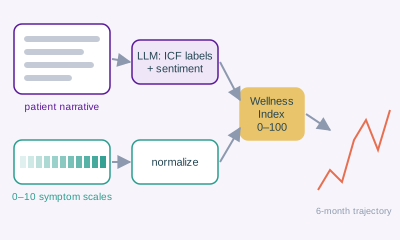
Schematic: patient narratives labeled by a language model and symptom scales are combined into a wellness index tracked over time
IS
Ishaan Sinha
High school · 2025

Quantifying patient narratives to strengthen longitudinal assessment in chronic pain

Combined language-model labeling of patient-written narratives (WHO functioning categories and sentiment) with numeric symptom scales into a 0–100 Wellness Index. He validated the labels against human annotators and tracked simulated patients over six months, then went on to explore the approach further with real patients.

Published · Young Scientist Journal (Vanderbilt), 2026 Live demonstration, IEEE/ACM CHASE 2026 (Pittsburgh) · Poster, Terra North Jersey STEM Fair 2026 Read the paper →
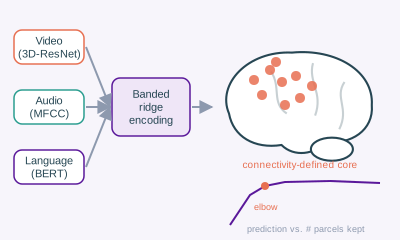
Schematic: video, audio and language features feed an encoding model that predicts brain responses; a connectivity-defined core is highlighted
VF
Viacheslav Fokin
High school · 2025

Functional connectivity localizes a distributed supramodal core for naturalistic viewing

Built multimodal encoding models that predict fMRI responses to movies from video, audio, and language features (Algonauts 2025 Challenge). He then used each region's functional-connectivity strength to identify a compact core of brain regions, overlapping known multimodal hubs such as the superior temporal sulcus, that carries most of the predictive signal.

Poster, CCN 2025 (Amsterdam) · First-author bioRxiv preprint 15th on the final leaderboard, Algonauts 2025 Challenge Read the preprint →
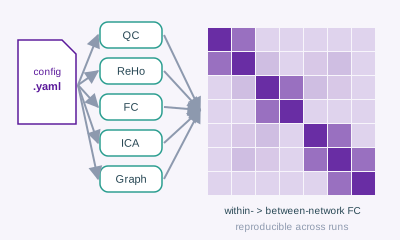
Schematic: a YAML configuration file drives QC, ReHo, FC, ICA and graph modules, producing a network connectivity matrix
SP
Sara Pradhan
High school · 2025–26

A configuration-driven Python pipeline for reproducible functional brain network analysis

Built an open-source, modular fMRI pipeline controlled by a single configuration file, covering quality control, regional homogeneity, static and dynamic connectivity, ICA, and graph metrics. She validated it on public OpenNeuro data and tested how sensitive results are to preprocessing choices.

Completed paper · open-source code
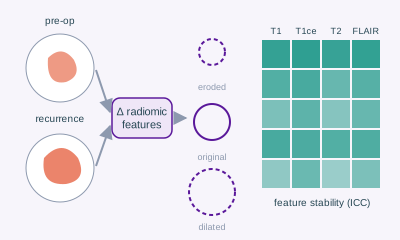
Schematic: pre-operative and recurrence tumor masks, perturbed segmentations, and a feature-stability heatmap across MRI modalities
DL
Daniel Lee
High school · 2025

Stability-informed feature selection for delta-radiomics in glioblastoma

Extracted longitudinal MRI radiomic features from public glioblastoma scans (TCIA). He tested which features stay stable when the tumor segmentation is eroded, dilated, or shifted, using intraclass and rank correlation across four MRI modalities.

Completed paper
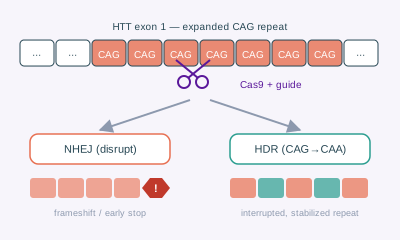
Schematic: Cas9 cuts an expanded CAG repeat, leading to either a disruptive NHEJ outcome or a stabilizing HDR outcome
IK
Isabelle Kim
High school · 2025

CRISPR–Cas9 strategies to modify the HTT CAG repeat in Huntington's disease

In-silico simulations comparing disruptive (NHEJ) and stabilizing (HDR, CAG→CAA) edits on synthetic HTT alleles. HDR shortened the uninterrupted CAG tract without changing polyglutamine length, moving alleles toward lower-risk categories.

Completed paper
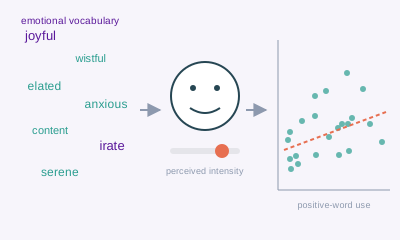
Schematic: emotion words, a face rating task, and a scatter plot relating vocabulary to perceived intensity
AJ
Aditi J.
2026 · co-mentored

The relationship between emotional vocabulary and measures of external emotional perception

Designed and ran an online survey that paired an emotion-vocabulary inventory with face-rating tasks, to test whether a richer emotional vocabulary changes how people perceive the intensity and valence of others' emotions.

Completed paper
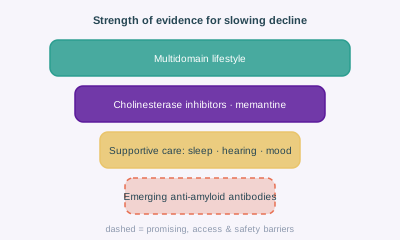
Schematic: tiers of evidence for interventions that slow cognitive decline in Alzheimer's disease
KW
Khaing Su Wai (Snow)
2025

Evidence-supported interventions for delaying cognitive decline in Alzheimer's disease

A review of randomized trials, meta-analyses, and guidelines comparing lifestyle and drug interventions. Multidomain lifestyle programs showed the strongest evidence, and the review weighs the promise and the access barriers of new anti-amyloid antibodies.

Completed paper
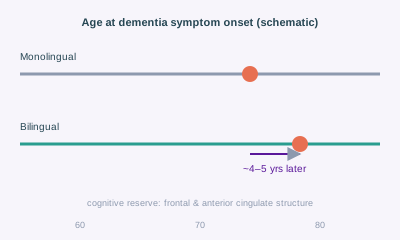
Schematic: dementia symptom onset shifted later for bilingual compared with monolingual adults
MS
Syeda Mahum Sattar
2025–26

Bilingualism and cognitive reserve in aging

A structured review of behavioral and neuroanatomical studies on whether lifelong bilingualism builds cognitive reserve that delays dementia symptoms. It treats the evidence carefully, as association rather than proof of protection.

Completed paper
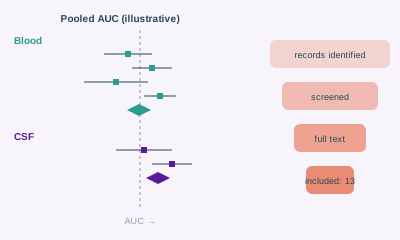
Schematic: forest plot comparing pooled diagnostic accuracy of blood and CSF biomarkers, with a PRISMA screening funnel
AJ
Ayaan Jani
High school · 2026

Blood vs. cerebrospinal fluid liquid biopsy with machine learning for glioma detection

A PRISMA-guided systematic review and meta-analysis that pools reported diagnostic accuracy (AUC) to compare blood-based and CSF-based biomarker panels paired with machine-learning classifiers.

In progress
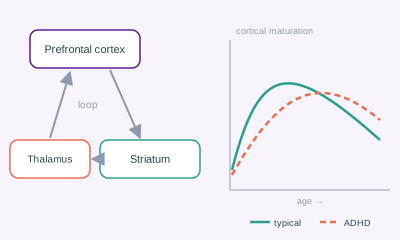
Schematic: prefrontal-striatal-thalamic loop and a delayed cortical maturation curve in ADHD
EH
Elena Ha
2026

Frontostriatal circuit development and executive function in childhood ADHD

A review drawing together structural MRI, diffusion imaging, and resting-state and task fMRI. It asks whether executive-function deficits in ADHD reflect delayed maturation of brain networks rather than a single damaged pathway.

Completed paper
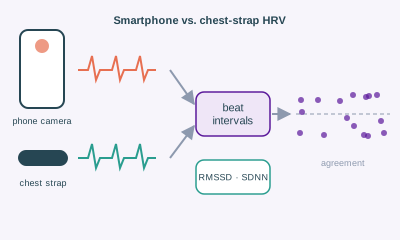
Schematic: heart signals from a smartphone camera and a chest strap compared through beat intervals and HRV metrics
MY
Heeseong (Mickey) Yang
High school · 2026

Validating smartphone-camera heart rate variability against a chest-strap reference

Simultaneous recordings from a smartphone camera app he developed and a Polar H10 chest strap. The study tests how accurately short phone recordings measure HRV (RMSSD, SDNN) across adult age groups.

Data collection complete · analysis in progress

Figures are illustrative schematics of each project's design, not reported results.

Programs

I mentor students independently and through these research programs:

Interested in doing research with me?

Tell me a little about your background and what you're curious about.

Get in touch